
Getty Images on Unsplash
I work in AI. I come from three generations of educators. The research says we’re making a catastrophic mistake.
I work in AI every day. I build with it, research it, and write about it. I also come from three generations of educators — teachers, coaches, school administrators — and I’m raising a ten-year-old.
So when I hear “we need to get AI into classrooms,” I hear it from both sides. And the evidence says we’re about to make a catastrophic mistake.
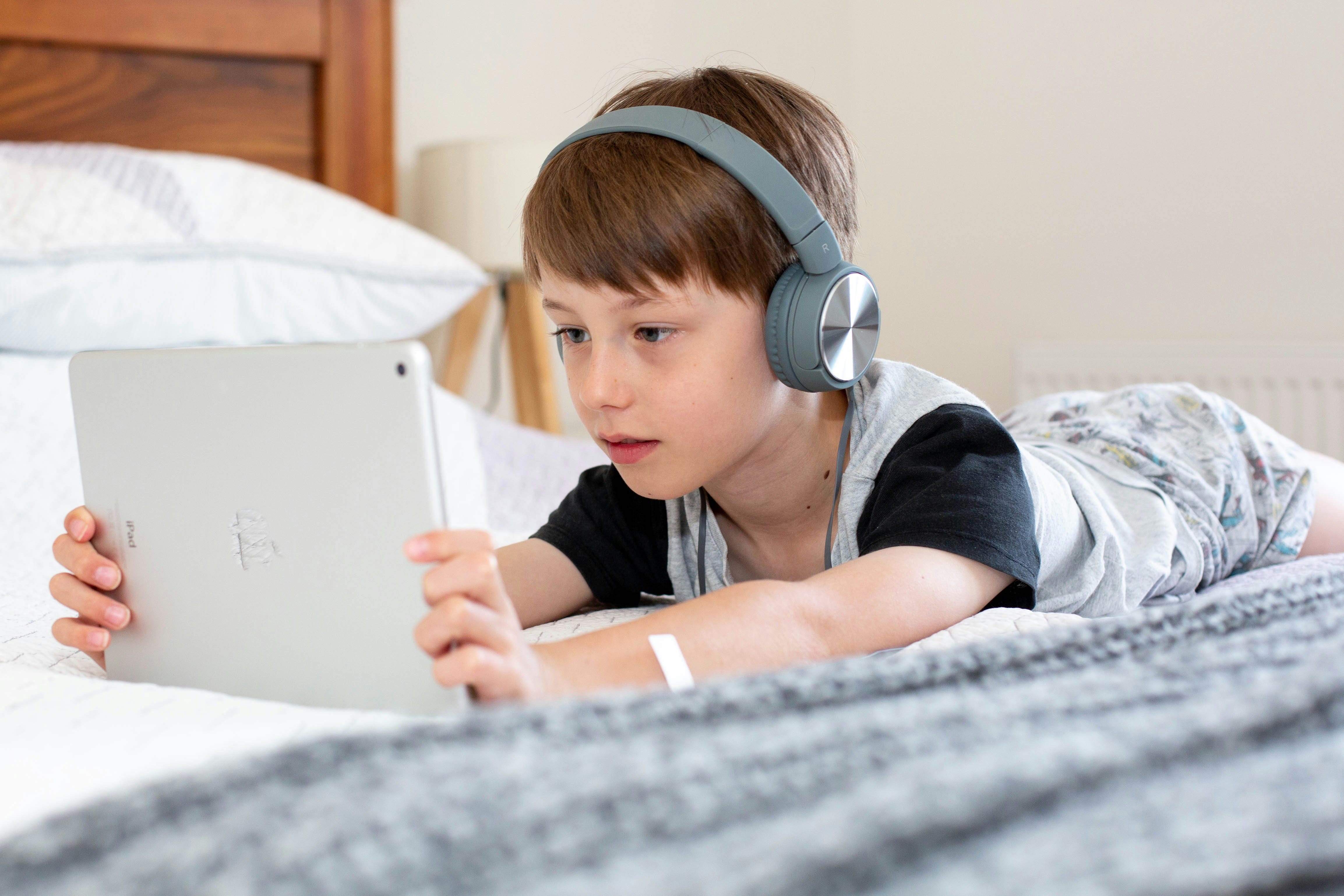
Here’s the core problem: AI in the classroom is a screen. That’s it. Whatever pedagogical wrapper you put around it, you are adding screen time to children who already have too much of it, in an environment specifically designed to develop their capacity to think. And the research on what screens do to developing brains is no longer ambiguous.

The damage is measured, not speculated.
A 2025 meta-analysis in the APA’s Psychological Bulletin — 117 longitudinal studies, roughly 293,000 children — found that screen use predicts later socioemotional problems, and those problems predict more screen use. It’s a feedback loop. Gaming showed the strongest harmful effects. And the longer you track kids, the worse it gets: effects more than doubled when measured over four or more years.
MRI studies of preschoolers show lower white matter integrity in brain regions governing language, literacy, and executive function — the very capacities that education is designed to build. CDC data on teenagers finds depression symptoms at nearly three times the rate in kids with four-plus hours of daily screen time. A randomized controlled trial published in JAMA Network Open demonstrated that just two weeks of reduced screen time causally improved children’s mental health.
The AAP says no screens before 18 months and strict limits through age five. The WHO is even stricter. Three in four children under 2 are already using screens, and 87% of kids exceed the AAP’s recommendations.
Jonathan Haidt’s The Anxious Generation synthesized data across 37 countries to document the shift from play-based to phone-based childhood. Critics contest the magnitude of harm — but none of them argue we should be adding more.

Meanwhile, AI adoption in schools has doubled in a single year, with almost no evidence that it improves student learning.
RAND found 53% of teachers used AI in 2025, up from 25% the year before. The Center for Democracy and Technology reports 85% of teachers and 86% of students used AI tools. Yet only 45% of principals say their school even has a policy on it. More than 80% of students say no teacher ever taught them how to use AI for schoolwork.
The research base for AI tutoring effectiveness in K-12? A systematic review in Nature’s npj Science of Learning found exactly 28 studies with a total of 4,597 students — all quasi-experimental, no true randomized controlled trials. The effects were “mitigated when compared to non-intelligent tutoring systems.” The most-cited positive result involved college undergraduates over two weeks, measuring short-term recall. That’s the best the field has.
The evidence that AI impairs learning, though? That’s growing fast.
Anthropic’s own RCT found AI-assisted developers scored 50% on comprehension versus 67% for those who coded manually — a 17-point gap, with the worst performance on debugging, the skill that matters most. A Budapest university study found that students with unrestricted access to AI became so dependent that, when it was taken away, they escalated their complaints to Hungary’s State Secretary for Higher Education. A study of 153 high school programmers who used ChatGPT found lower self-efficacy, engagement, and achievement. Microsoft Research found that higher confidence in AI correlated with less critical thinking.
A cognitive offloading study found a correlation of −0.68 between AI usage and critical thinking scores. The youngest participants — ages 17 to 25 — showed the highest dependence and the lowest thinking scores.
Read that again. The people most at risk from AI-assisted cognition are the youngest users. And we want to start them in elementary school.
The counterarguments don’t withstand the scrutiny of the research.
“Kids need AI literacy.” A scoping review identified 16 empirical papers across the literature on AI literacy in early childhood education. No peer-reviewed study demonstrates that early AI exposure improves any cognitive, academic, or developmental outcome. The argument is aspirational. It is not evidence.
“They’re digital natives.” Kirschner and De Bruyckere demolished this in Teaching and Teacher Education: “Information-savvy digital natives do not exist.” Research across 13 universities found that students had weaker digital skills than assumed. Nature called the digital native “a yeti with a smartphone.” Growing up with technology creates familiarity, not mastery.
“It’s like the calculator.” No. A calculator fills a computational gap — you still need to understand the math, choose the operation, and interpret the result. AI fills a cognitive gap. A student can input a prompt and receive a complete essay without understanding anything about the subject. Calculators are deterministic and accurate; AI hallucinates. Calculators are narrow; AI operates across every domain. When you forget how to do long division, you notice. When you lose the ability to reason clearly, you don’t.
“Ed-tech will transform education.” The OECD tested this across 31 countries and found “no appreciable improvements in student achievement” from heavy technology investment in schools. Students using computers most frequently performed significantly worse. The U.S. has spent an estimated $60 billion putting technology in classrooms with little measurable effect.
Here’s what actually works. It’s not new. It’s not disruptive. It’s human.
John Hattie’s Visible Learning synthesis — over 1,800 meta-analyses covering more than 300 million students — found the most powerful influences on learning are overwhelmingly human: collective teacher efficacy, teacher credibility, classroom discussion, scaffolding, feedback, and the teacher-student relationship. Technology-centered interventions consistently rank lower.
A Cambridge meta-analysis of 39 studies found that guided play outperformed direct instruction on early math, shape knowledge, and spatial vocabulary. A review of 147 studies found measurable academic and well-being benefits from outdoor, nature-based learning.
And here’s the punchline: phone bans work. An NBER study of a major Florida school district found that test scores improved by 1 percentile in the second year of a phone ban. A Wharton RCT with 17,000 students found that collecting phones at the start of class raised grades, and the lowest-performing students benefited most, with an effect nearly double the average. The researchers concluded: phone bans can cut achievement gaps.
Less screen. More human. Better outcomes. The data is not complicated.
This is where my work in AI and my family’s work in education converge.
I study AI because I care about its impact on human cognition. In my research, I distinguish between prosthetic AI — tools that do tasks for users — and therapeutic AI — tools that rebuild user capacity. Every AI tutor pitched to schools today is prosthetic. It does the thinking, so the student doesn’t have to. That’s not education. That’s dependency marketed as innovation.
My grandfather taught. My mother taught. I taught. We all understood something the ed-tech industry refuses to learn: the struggle is the point. The productive friction of not knowing, of working through confusion with a human guide who knows your name — that’s where cognition develops. You cannot automate that. You can only replace it with something that looks like learning but isn’t.
87% of principals say AI could make it less likely that students develop critical thinking. 7 in 10 teachers say AI weakens the skills students need. Half of students say using AI in class makes them feel less connected to their teacher.
They’re telling us. We’re not listening.
The global AI-in-education market is projected to reach $137 billion by 2035. There’s a lot of money in not listening.
I’ll keep building with AI. I’ll keep my daughter away from it. Those aren’t contradictions. They’re the same position, held by someone who reads the evidence.
🧡
Sources and full bibliography available — comment or reach out and I’ll share the research brief with 40+ cited studies.


Leave a Reply