Drew Beamer from Unsplash
Seven studies and 84 sober days later, I understand why habits actually stick.
I wrote a post about forming a habit in 2021. The truth is: I wasn’t ready. Not for the habits. Not for the honesty required to build them.
Back then, I was trying to force something I hadn’t actually built yet. I attempted to write for sixty days in a row. I endeavored to meditate consistently. Not only that, but I set out to “become a person who does the thing.” And I wrote publicly about habit formation before I’d actually lived it.
I quietly failed at what I was attempting. And I’ve carried that with me for years — not the failure itself, but the misunderstanding of what habits really are and why they don’t stick.
This year, something changed. I’m 84 days sober, with 73 days straight of daily writing and meditation. And after reading seven more recent studies on habit formation — from neuroscience to philosophy — I finally understand why.
This is a habit update, yes.
But more importantly, it’s a reframing of what habit actually means.
I can now say that I’m in my second bout of sobriety, and I even wrote a book about it to dynamite-kaboom my bridge back to drinking.
I’ve formed three major habits, they’re working marvelously for me, and I’m quite proud of them.
- 84 days sober
- 73 days writing
- 72 days meditating
I missed a day in my meditation streak when I got sick recently, but I’ve been doing all of these things for about eleven to twelve weeks now. This is alongside voraciously reading everything I can get my hands on, but that’s less of a habit and more of just a behavior change now my mind is free from being buzzed or hungover regularly.
I wanted to revisit my post I wrote, since I finally accomplished what I set out to from that day.
“Author’s note: I’ve decided that writing is important enough to me that I want to make a regular practice of it.”
Good job, David. You finally got there.
The Problem with “21 Days” — What the Research Actually Says
There’s a lot of bullshit out there about how a habit can be formed in 21 days. As I wrote about previously, this comes from an assertion regarding how long it takes folks getting plastic surgery to adjust to their own mental image.
No joke.
The 21 days thing has a source from a plastic surgeon named Dr. Maxwell Maltz, writing in a book called Psycho-Cybernetics — A New Technique for Using You Subconscious Power. You can’t make this stuff up, but it’s been touted around the Internet for years now.
Let’s check in with recently peer-reviewed published papers instead. Quite a few have been published since 2021 when I first wrote about the topic. Why don’t we use those instead?
From The University of South Australia and the Alliance for Research in Exercise Nutrition and Activity, we can find a paper from Singh et al., 2024.
There, we discover a few important things to debunk the 21-day nonsense:
- Habit formation median time: 59–66 days
- Mean: 106–154 days
- Individual ranges: 4 to 335 days
“Emerging evidence on health-related habit formation indicates that while habits can start forming within about two months, the time required varies significantly across individuals.”
Hardly 3 weeks worth of time across all populations. This indicates that habits take time, and the formation of them can happen over a much longer period for some people.
I’ve hit that median mark with my 3 habits, and I’m still going, and I’m pleased to report that keeping them going seems like a very possible and obtainable future for me.
I keep track of these things across:
- My Journal — DayOne
- My Sobriety App — I Am Sober
- My Meditation App — Calm
Habit formation is not just “doing a thing repeatedly,” but building automaticity in a system that fights back.
We are beings that burn energy. Our bodies and minds are in a constant state of energy conservation.
Your brain actively tries to take the courses it’s most used to, to achieve the least amount of drag upon your existence.
Forming a habit is more than just behaviors — you’re physically re-wiring your brain that already has complex interconnectedness and pathways to continue the behavior that you’re used to.
The Deep Science — Habit as Brain Network Restructuring
Understanding the fact that habit formation is not just about behaviors, but an actual rewiring of your brain was key, helping me understand the amount of work actually necessary to make it happen.
Out of Tokyo and the Department of Psychology in Keio University comes a study from Kota Yamada et al., in 2023. There, we discover that there are not competing areas of the brain trying to establish habits, but a single network that restructures itself based on habit formation. Previously, scientists thought that goal-directed behavior was split into two places in the brain:
- Deliberate action → prefrontal cortex
- Habit → striatum
Turns out, it’s not a separate set of actions working against each other, but a single network that restructures itself and draws new pathways as habits form. The hippocampal-prefrontal circuit (hippocampus ↔ prefrontal cortex) supports both behaviors, and the efficiency changes as habits form.
“Habit formation can be viewed as the optimization process of energy consumption by the organism.”
For me, this helped to explain why it felt like creating a habit was so much work and there was so much fighting, internally, keeping me from the goals I was trying to achieve. I wasn’t trying to fight internally from one area of my brain to another, I was actively digging new trenches for the flow to occur.
Sobriety stopped being a daily decision → it became the default.
Writing shifted from effort → identity.
Meditation stopped being a chore → became a morning pattern.
Sobriety stopped feeling like “not drinking” and just started to feel like, me.
Another thing that helped me along the way for forming new habits and becoming this new person I wanted to be was an identification of my personal mission statement and values.
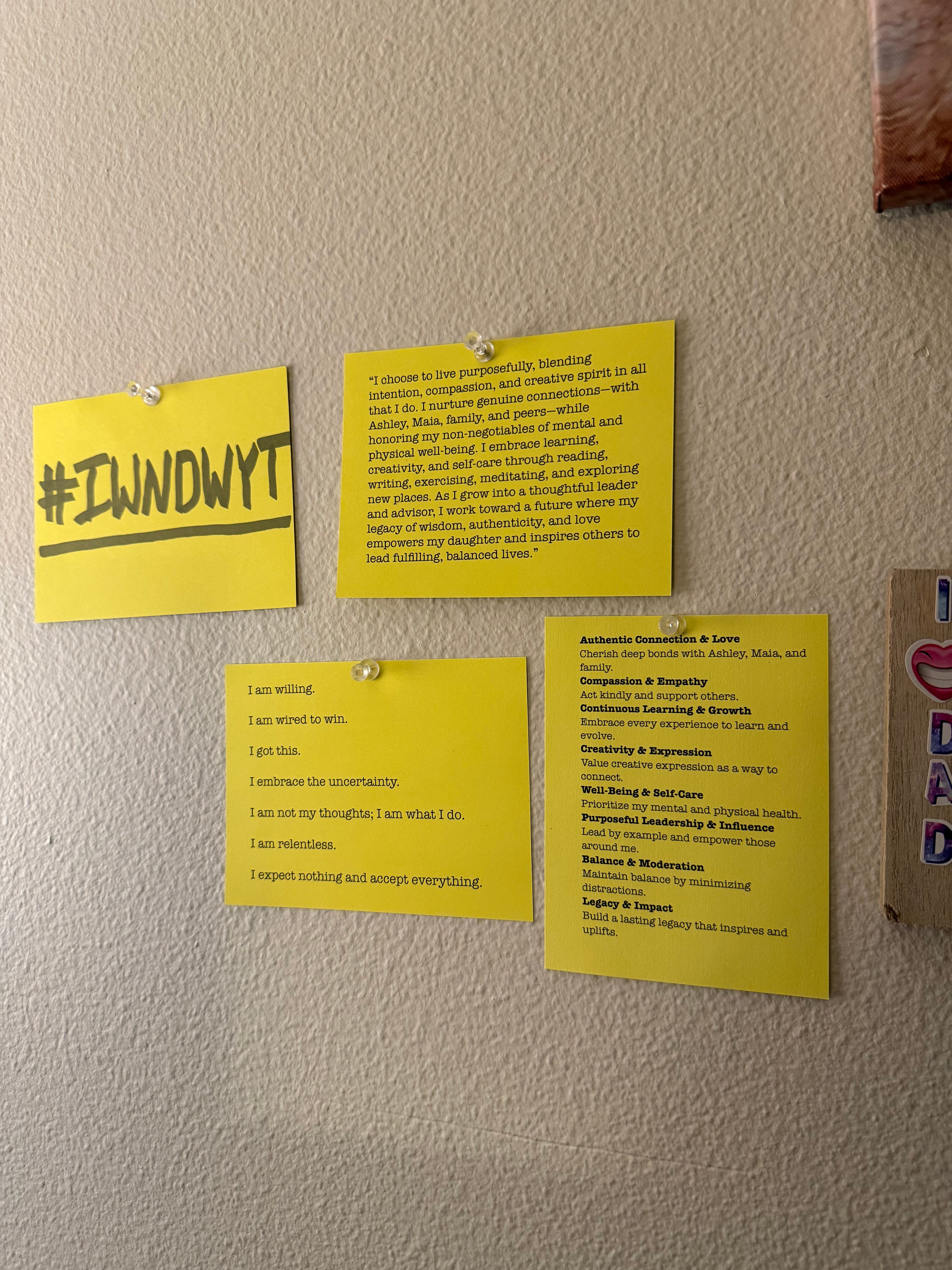
Coming up with my personal mission statement, printing it out, and putting it on my wall above my laptop while working was one of the more powerful things I did for myself.
It was a constant reminder of who I wanted to be and how I wanted to show up in the world. Alongside mantras from the wonderful Unf*ck Yourself by Gary John Bishop, these guides led me toward a path of self-enlightenment and offered me clarity when I wasn’t sure what I was supposed to be doing with my time.
Turns out, there’s a study to reinforce the thoughts that long-term goals can be achieved through the formation of habits.
“Once established, habits help you automatically achieve long-term goals … Psychology has focused on self-control…perhaps reflecting a lingering sense of the Puritan grace in self-denial … If habits become inconsistent with goals, then they challenge self-control-efforts.”
These quotes come from Beyond Deliberate Self-Control: Habits Automatically Achieve Long-Term Goals from Stojanovic and Wood.
Turns out, establishing my goals first and my habits second was part of the work necessary to reinforce both the completion of the habits and the completion of the goals.
Sobriety and habit formation was really only possible once the habit aligned with my identity goal:
- Being a present father
- Being the man Ashley married
- Being a writer, not a drinker
- Building a life with fewer secrets — being vulnerable
Turns out it wasn’t big sweeping changes that allowed me to start to live the life I wanted to lead. It was the tiny units of time, effort, and self-talk that got me there:
- Write one sentence
- Meditate for ten minutes
- Say “I will not drink with you today”
- Read one page
These lead me to:
- Write an entire book, start sharing online, and multiple Medium articles
- A meditation practice that happens every day
- No more drinking, ever
- Finishing dozens of books
I discovered there’s good research to support this, too. From “Small changes, big impact: A mini review of habit formation and behavioral change” by Akash and Chowdhury, in 2025, we discover tiny daily steps actually lead to huge identity shifts.
“Gradual modifications lead to more sustainable outcomes compared to drastic feedback.”
It reinforces the excellent work from folks like Clear in his Atomic Habits book. The “strategic use of environmental design, consistent practice, and replacing negative habits with constructive alternatives underscore the complexity of habit development.”
It’s a lot more than just saying you want to do a thing, it’s adopting many tiny behaviors that lead to the aforementioned changes in your brain necessary for a habit to form.
Digital Habit Design — Why Apps Help at First But Not Forever
It’s worth mentioning that the apps I mentioned earlier were key in helping me to get started. Having an app to check in on and making that a daily part of my process was huge in the beginning. I needed the reinforcement from them to get those little hits of happy chemicals to help me along the way.
A smile crossed my face when the little 🔥 symbol in DayOne indicated I was on a streak. I got a kick out of seeing the calendar fill up in my Calm app. I was constantly reminded in the second by second progress and milestone hitting from I Am Sober. These apps were tremendously helpful in the beginning.
They gave me something to turn to each day to find that I was making progress along the way. I still use them today, but they’ve become less important reinforcements as I’ve started to simply find myself being a new person instead of a person desiring change.
This shift in usage, it turns out, isn’t unfounded or uncommon, as we learn in Digital Behavior Change Intervention Designs for Habit Formation by Zhu et al. out of The Hong Kong Polytechnic University in 2024. There, we find using apps to start the habit-formation process is a very helpful push to get to where you’re going.
However, for most people, the automaticity took over and was ultimately responsible for forming the habit in the later stages of behavior transformation. I still track my reading, writing, sobriety, and meditation in various apps, but I’m less reliant on them when it comes to looking at them to see the behavior change.
I am the behavior change now.
When I accidentally missed a day for meditation while I was sick after I had hit 60 days in a row, I wanted to be hard on myself. My old self would have told me: “see, you can’t do it.” But the new me brushed myself off, and immediately told myself: “well, looks like you’re going to have to start anew and this time, you’ll make it 90 days.”
This shift alone — in my ability to recognize how far I had come and how possible it was to make it even farther — was a significant shift for me, both in my growth as a human and the self-love I have allowing me to get to where I want to be.
Additionally, my path to sobriety wasn’t a straight line. I clocked a year and a half of sobriety a couple of years ago and fell off the wagon for a while. I thought I’d be fine with being an occasional drinker, but the truth was: I was silently struggling for a few years attempting to be someone I was not. Furthermore, I am not the person who can just have a drink here and a drink there. I am much happier without alcohol in my life, defining who I am and what I want to be doing.
As mentioned earlier, the journey towards forming a habit isn’t just a 21-day journey for people, or a 60-day journey for everyone — for some it can take many months. Baretta et al., out of The University of Bern in Switzerland, found this about physical habits in 2025:
“Habit trajectories were highly idiosyncratic.”
See? The science agrees that you have no reason to be hard on yourself if your habit-forming journey doesn’t fall in line with others you’re seeing on Instagram or elsewhere on the Internet. Your journey has to be:
- For you
- By you
- Uniquely you
A Philosophical Framing — Dewey and Habit as Identity Reconstruction
This all leads to the last bit of our article, where we discover a paper diving into the philosophy of habit-forming outside the science, based on John Dewey.
By taking a look at the science behind habit-forming, we can find a few things to be very true:
- The journey isn’t linear for anyone
- It most often takes far longer than 21 days
- Expect to spend at least 60 days if not more before you get there
- Small steps lead to big gains
- If you don’t know your goals, your habits may be harder to achieve
In Habit Formation and Change from a Deweyan Perspective, by Erik Yves Adalberon out of Sweden, we find that habits don’t just become automatic — they become part of who you are, and they can be rebuilt at any time.
“The essence [of habit] is an acquired predisposition to ways or modes of response — special sensitiveness or accessibility to certain classes of stimuli.”
Ultimately, the habits you establish start to define who you are as a person. They literally reshape what you respond to. The behaviors you accomplish and achieve daily serve as the foundation of how you show up in the world.
“Habits are not conserved in the sense that they remain unchanged throughout life, but instead continually change due to experiences of situations.”
Reinforcing the fact that the journey is not a straight path for anyone. We are complicated creatures living complicated lives, but we all change over time. Habits may form who you are now, but they can shift over time. I had a habit of drinking wine every time I cooked in the kitchen. That habit has shifted — now I play music every time I’m in the kitchen.
“It is a waste of valuable time to use repetition as a method to foster habits, since the result can end in an inflexible habit which has no mind in it.”
Blowing up the idea that you can just repeat yourself for 21 days and be done with it. Habits have to be formulated, and you have to adjust your life around it and embrace it before it can be considered a different way of how you do things.
“Successful action is the key to the formation of flexible habits, especially if we are concentrating our consciousness upon things that bring about our success.”
…and…
“Our desires take the form of aims and goals… habits are our prime instruments.”
Meaning, we must set goals in front of us and let the habits fill in those goals, not the other way around.
There are a bunch of other great quotes from the paper, but I’ll leave with a last one that wraps up what I got out of it:
“Habits are the mainspring of human action”
Your identity and who you are and how you show up in the world is a direct reflection of the regular things you do with your life.
What I Wish I Could Tell My Old Self
Figure out your mission statement and your values before figuring out what behaviors you need to achieve them. I’ll write more about this in the future, but for now, I wish I could’ve told myself I wasn’t there yet.
I wanted to do behaviors, I didn’t have a particular goal in mind. I knew what I didn’t want to be, and I knew some things I wanted to do, but I didn’t know how I wanted to show up in the world.
There are 7 values listed alongside my mission statement, but those have been distilled down to 2 core values thanks to the suggestion of Brené Brown.
- Authentic connection
- Continuous growth
My habits are the physical practice of those values.
Sobriety is how I protect authentic connection — it keeps me present with Ashley, with Maia, with my work, and with myself. Writing, reading, and meditation are how I nurture continuous growth — they turn curiosity into clarity, and reflection into action. Each repetition, each quiet morning, is a reaffirmation of who I’m becoming.
My habits aren’t boxes to check anymore; they’re expressions of what I care about most. They’re how I live my values instead of just naming them.
I am my behaviors, and I’m pleased to report those behaviors are who I want to be.

Leave a Reply