
Clark Tibbs on Unsplash
And the GPT That Helps You Build Yours
Most people don’t realize how easy it is to drift away from their own life. You start reacting instead of choosing. You say yes to things that don’t matter. You spend money on impulses instead of priorities. You waste time in ways that don’t line up with who you want to be. You lose hours, days, sometimes years, not because you’re lazy or unmotivated — but because you don’t have a clear compass pointing you back to yourself.
I lived that way for a long time.
Especially during the years when I was drinking too much, burned out, overwhelmed, and trying to muscle my way through everything with willpower. I didn’t know who I wanted to be — just who I didn’t want to be. And that’s not enough to steer a life.
Everything changed the moment I wrote my personal mission statement and values.
It gave me direction.
It helped me get sober.
It guided how I spend my time, money, energy, and attention.
It taught me what to say “yes” to — and more importantly, what to say “no” to.
Because once you know what you stand for, everything else becomes clearer.
And that’s exactly why I built My Personal Mission Statement Generator — a guided ChatGPT that helps you create a mission statement and set of values that actually feel like you.
But to understand why it works, you have to understand what the science says about identity, values, and story.
I. The Real Reason You Feel Scattered
There’s a reason life feels overwhelming even when things “look fine.”
Psychologist Roy Baumeister showed [1] that the constant churn of small decisions drains our mental energy long before we realize it. That decision fatigue leads to a feeling of drift — like you’re not steering the ship anymore.
You’re not alone in that.
Your brain is simply overloaded.
A mission statement cuts through that fog. It gives you what I never had before mine: a filtering mechanism. A quick way to check whether something aligns with the life you want to live.
II. Values Aren’t Fluffy. They’re Scientific.
Shalom Schwartz famously defined values as “trans-situational goals that serve as guiding principles in life”. [2]
His research shows:
- values shape how we behave
- values shape what we choose
- values shape what we tolerate
- values shape who we become
But here’s the twist: most people have never articulated their values clearly.
And when your values are unspoken, they run your life unconsciously.
When you name them — explicitly, simply — everything shifts.
Suddenly you’re living intentionally, not reactively.
III. Why a Mission Statement Changes You
Humans are narrative creatures. Dan McAdams puts it plainly:
“We are all storytellers, and we live by the stories we tell.”
When your story is vague, your life becomes vague.
When your story becomes clear, your life follows it.
A mission statement is a short, powerful story about who you are and how you choose to live.
Writing it isn’t fluffy self-help. James Pennebaker found that writing about emotional experiences produces improvements in mental and physical health, and Dr. Laura King discovered that writing about meaningful goals produces physical and psychological benefits.
Your brain responds to clarity.
Your decisions respond to clarity.
Your identity responds to clarity.
When I wrote mine, it was like someone turned the lights on.
IV. Why I Built a GPT to Guide You Through This
Most mission statement prompts online are lifeless. Worksheets feel clinical. Lists feel shallow. But conversation? That unlocks everything.
So I built a guided GPT that walks you through six categories:
1. Fulfillments
What brings you alive.
2. Non-Negotiables
What protects your well-being.
3. Growth
Who you’re becoming.
4. Reputation
Who you want to be known as.
5. Presence
How you show up every day.
6. Legacy
The story you’ll leave behind.
The GPT gathers everything you share, synthesizes patterns, and gives you eight personalized values plus your two “core guiding values” — the ones Brené Brown says everything else flows from.
Then it writes a mission statement in four grounded sentences.
Not corporate.
Not cliché.
Not generic.
Yours.
V. The Part That Actually Changed My Life
Here’s the thing no one talks about:
You have to see your mission statement for it to work.
I printed mine.
Put it next to my desk.
Read it often.
Research on self-affirmation shows that reconnecting with core values makes people more resilient under stress. Mindfulness studies show that repeated focus reshapes neural pathways. And identity research shows that consistency builds coherence.
Every time I looked at my mission, it shifted something inside me.
It helped me choose sobriety.
It helped me be a better dad.
It helped me lead with intention.
It helped me stop wasting time.
It helped me invest my money and energy in things I actually care about.
It helped me remember what matters when life felt chaotic.
Print it.
Put it somewhere visible.
Let it work on you.
VI. Ready to Build Yours?
If you want clarity…
If you want direction…
If you want to stop drifting…
If you want a compass for your decisions…
If you want a mission that pulls you forward…
Start here:
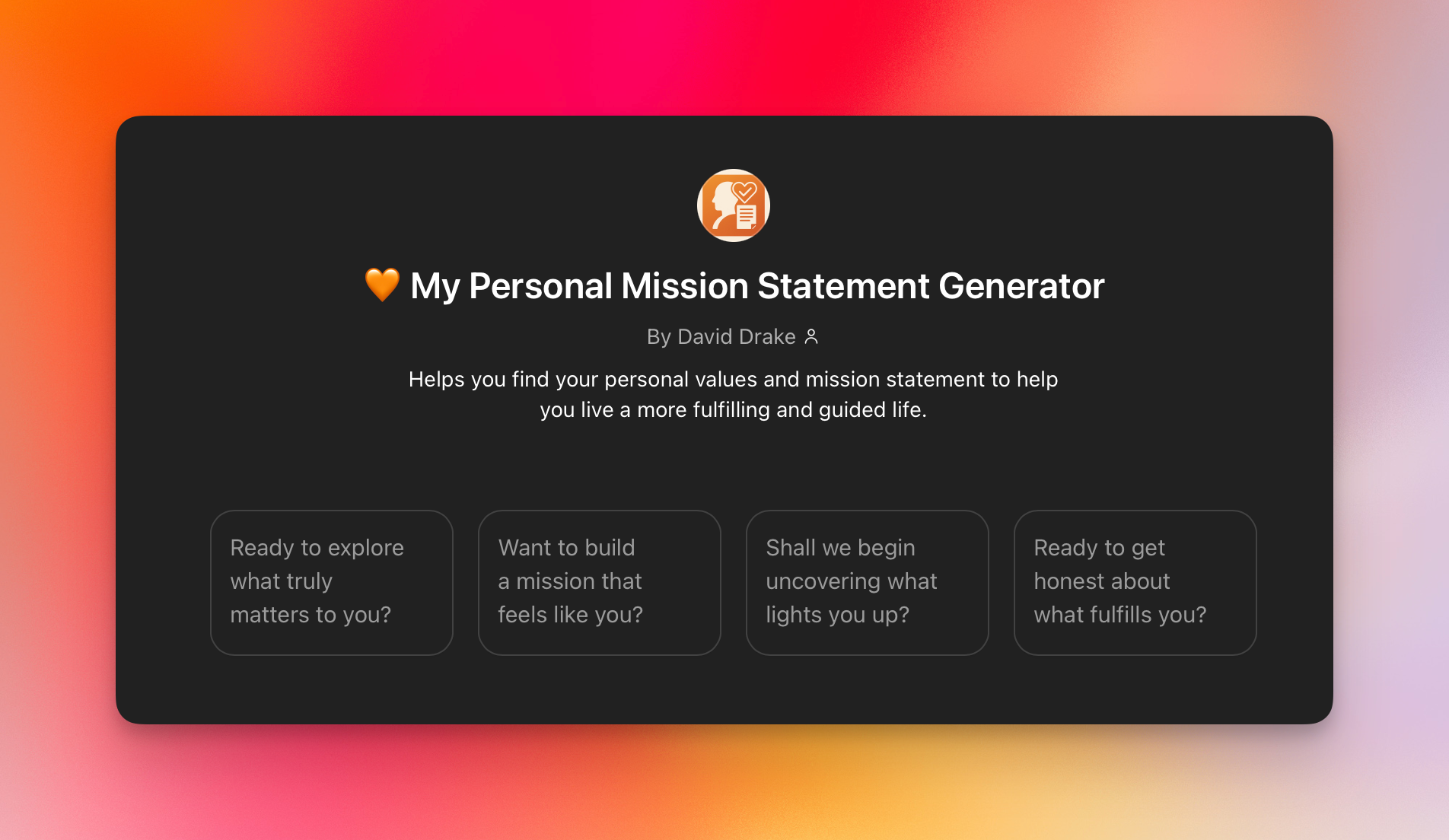
My Personal Mission Statement Generator
Go 👉 here 👈 and just tell it you’re ready to get started.
Give yourself ten quiet minutes.
Tell the truth.
Bring the names of people you love.
Let yourself be fully honest.
Then print what it gives you.
Put it where you can see it.
Let it shape your days the way it shaped mine.
Living with purpose isn’t an achievement.
It’s a practice.
And you can start yours today.
VII. The Non-Negotiable Truth
Let me be blunt for a second, because this is the part I wish someone had shouted at me years ago:
You cannot afford to keep your mission and values in your head.
They must live where you can see them every single day.
Not once a month.
Not when things fall apart.
Not “when you remember.”
Every day.
The science backs this up. Self-affirmation research shows that reconnecting repeatedly with your core values literally changes how your brain responds to stress. Mindfulness studies show that attention reshapes the neural pathways that drive identity and behavior. Expressive-writing studies show that returning to your goals deepens motivation and well-being.
But here’s the real reason:
Your environment controls your behavior far more than your intentions do.
If you want your mission to guide your life, it has to live in your environment:
- printed
- visible
- near your workspace
- somewhere you cannot ignore it
This is non-negotiable.
When I printed mine and put it next to my desk, everything changed. Not because the words were magical — but because the words were in front of my face at the exact moments I needed them.
Every decision.
Every priority.
Every temptation.
Every moment of overwhelm.
Every question of whether to say yes or no.
My mission was right there saying:
This is who you are. Stay loyal to that.
It helped me get sober.
It helped me refocus my career.
It helped me protect my time, energy, money, and relationships.
It helped me choose with clarity rather than mood.
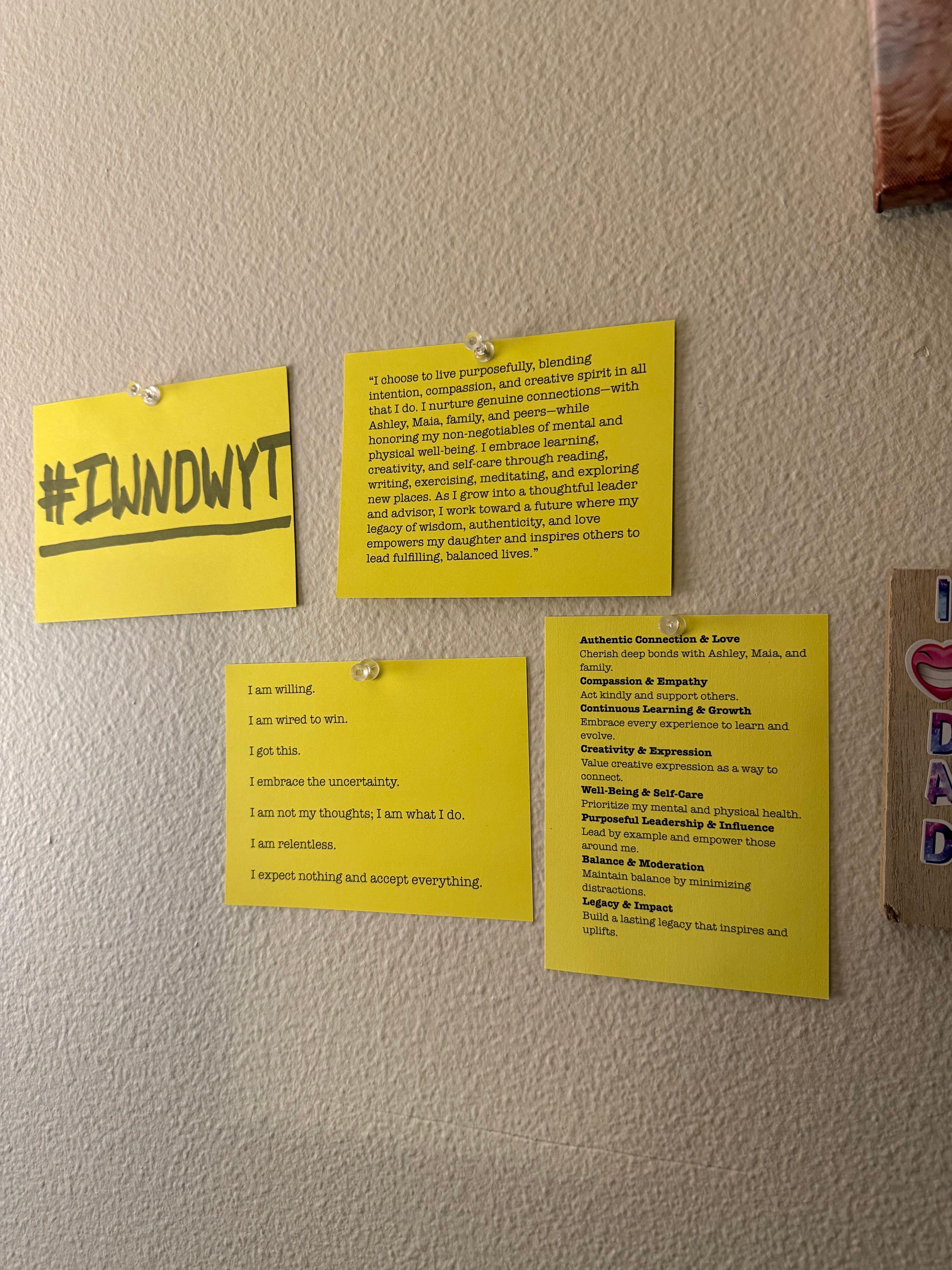
If you do nothing else with the GPT — if you never use another tool, another worksheet, another prompt —
Print your mission. Post your values. Put them where you live your life.
It will quietly change everything.

Leave a Reply